For the leaders who answer for AI in regulated organisations, across technology, risk, compliance and audit: why a sourced AI answer is not a correct one, and how to verify AI answers before they reach a regulator.
Key takeaways – A citation shows where an answer came from, not that it is right, and in regulated work that gap is where the cost hides. – Stanford’s 2026 AI Index puts hallucination rates across 26 top large language models (LLMs) between 22% and 94%, so confident, sourced, wrong answers are common, not rare. – RAG helps but is not enough: grounding an LLM in your documents cuts hallucination, it does not verify the answer. – Verify AI answers by demanding five behaviours: answer only when sure, cite what was used, say what is missing, check the claim against the source, and log the calls that matter.
In regulated work, the answer that hurts you is not the one that looks wrong; it is the one that looks finished.
And that is the most common problem: a sourced answer is not a verified one, because a model can cite the right document and still get the conclusion wrong. A citation tells you where the answer comes from, not that it is the right one.
In everyday use, a wrong answer just costs you a little time. Inside a regulated operation, a bank, an insurer, a hospital, an energy operator, the same wrong answer can turn into something you have to report to a regulator, a compliance breach, a bad decision that lands on a real customer, or, worse, actual harm to someone, and the answer that gets acted on is almost never the obviously broken one.
None of this is a rare edge case. Stanford’s 2026 AI Index puts hallucination rates across 26 top LLMs between 22% and 94% (Stanford HAI, 2026), which raises a question most teams cannot answer: if a regulator asked you tomorrow to prove that one of your AI’s answers was correct, could you? Most can only prove that it was sourced.
What follows is the standard a trustworthy answer has to meet in a regulated setting, and a way to hold your own systems to it.
In this article – Why a sourced AI answer can still be wrong – Retrieval is not verification – How to verify an AI answer in regulated work – Where to keep a human – How to evaluate a verification approach – FAQ
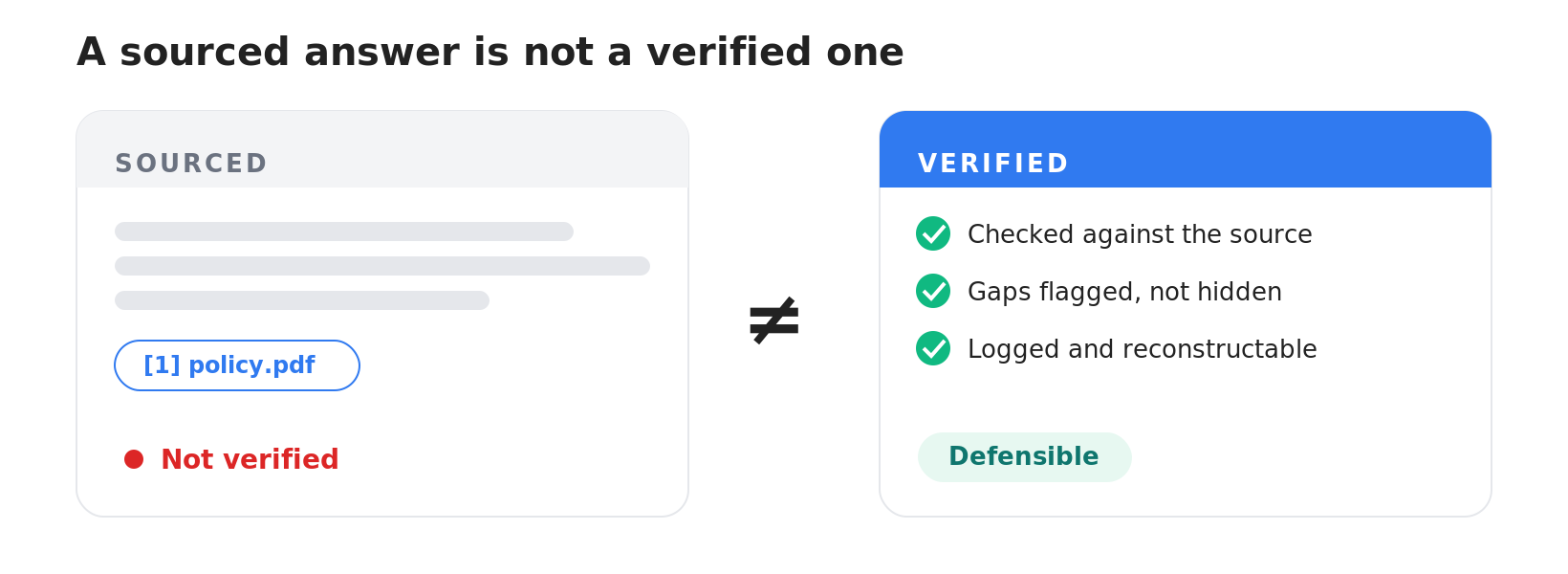
A sourced answer is not a verified one. A citation shows origin, not correctness.
Why Can a Sourced AI Answer Still Be Wrong?
Because a citation proves origin, not correctness. An answer you can trace is one you can start to trust, but tracing is where the check begins, not where it ends. An LLM can quote exactly the right document and misread its scope, or pull the correct table and carry the wrong number out of it, and in both cases the citation stays intact while the answer does not.
This is the failure teams notice last, because the outputs that fool an experienced reviewer are never the broken ones. They are the polished ones: clean structure, a citation on every line, and a conclusion that falls apart the moment someone checks it against the source. Looking right is a feeling, and a feeling is not a control.
It is also why this is becoming the standard rather than a nice-to-have: a system nobody can defend in front of a regulator does not scale, it stalls in the pilot and never ships.
Retrieval Is Not Verification
Retrieval finds a source that looks relevant, while verification proves the claim actually holds against an authoritative one, and that difference is the whole game. Retrieval-augmented generation, or RAG, helps: it grounds the LLM in your own documents and cuts hallucination sharply. But grounding is the floor, not the finish line, because RAG does not verify the claim, and it does not make an LLM that does not know admit it. What turns a fluent answer into a trustworthy one is the system built around the LLM: retrieval to ground it, verification to check it against the source, and the discipline to make it flag what it cannot confirm.
That is why the mistake that actually costs you in regulated work is not the obvious one, it is the plausible one: the broken answer gets caught, but the fluent, confident, well sourced answer that happens to be wrong sails through, because nobody re-reads what looks complete. Completeness is the one quality you cannot verify by looking.
How Do You Verify an AI Answer in Regulated Work?
You demand five behaviours, and each one takes something you would otherwise have to catch by hand and builds it into the system:
- Answers only when it can. If it does not know, it says so, instead of filling the silence with a confident guess.
- Cites what it used, so every claim traces back to a source and nothing rests on assertion alone.
- Says what is missing, rather than papering over the gap.
- Checks the claim against the source, not just a related one, so a citation becomes confirmation instead of decoration.
- Escalates and logs the calls that matter, so a person can confirm the hard ones and you can reconstruct later how the answer was reached.
Together they turn a plausible answer into a defensible one, because the goal is not an AI that always has an answer, it is one that knows when it does not and says so.
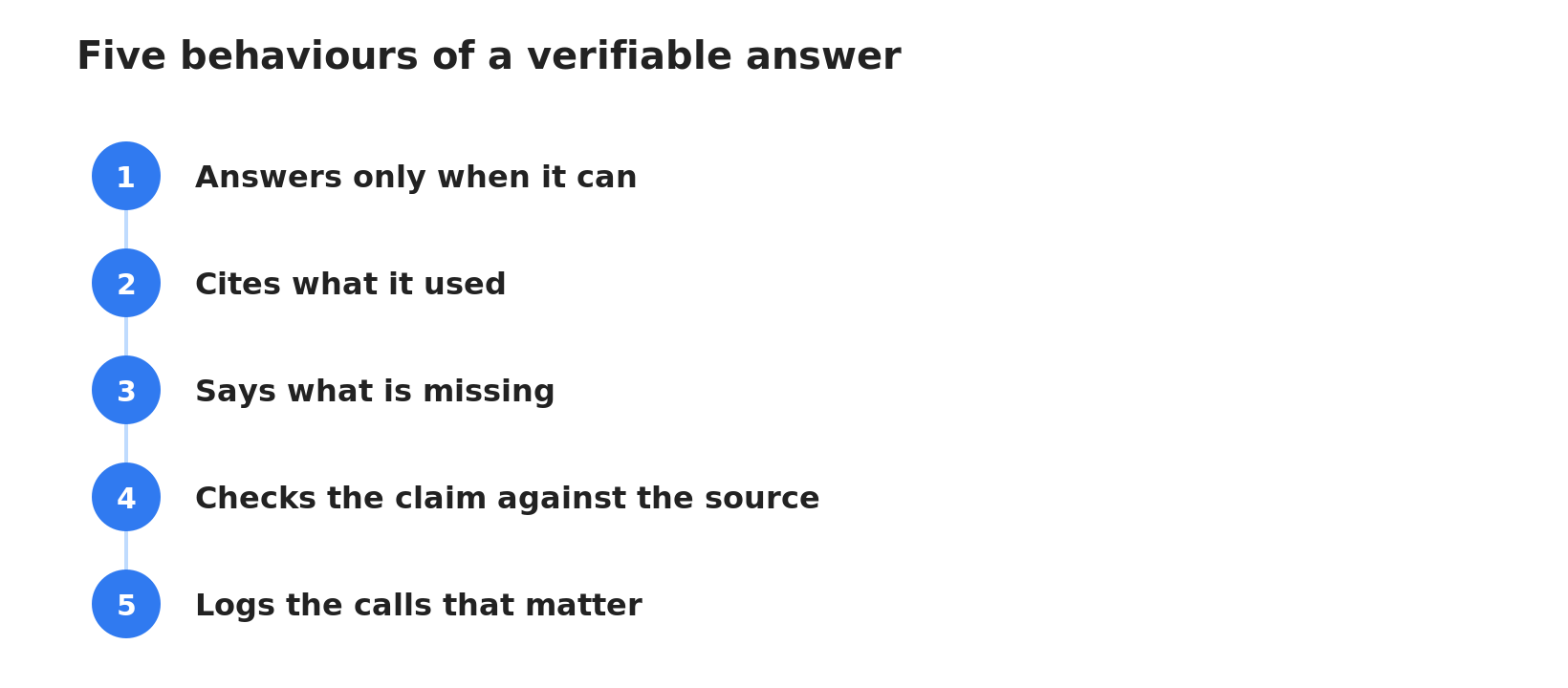
The five behaviours that turn a plausible answer into a defensible one.
How you build that matters as much as what you build. Verification designed into the way an answer is produced is a different thing from a guardrail added at the end to filter or narrow what the model already said. An add-on like that catches only some bad outputs, after the fact, while verification built in from the start decides, at each step, whether it should be answering at all, which makes it far harder to bypass and far easier to defend.
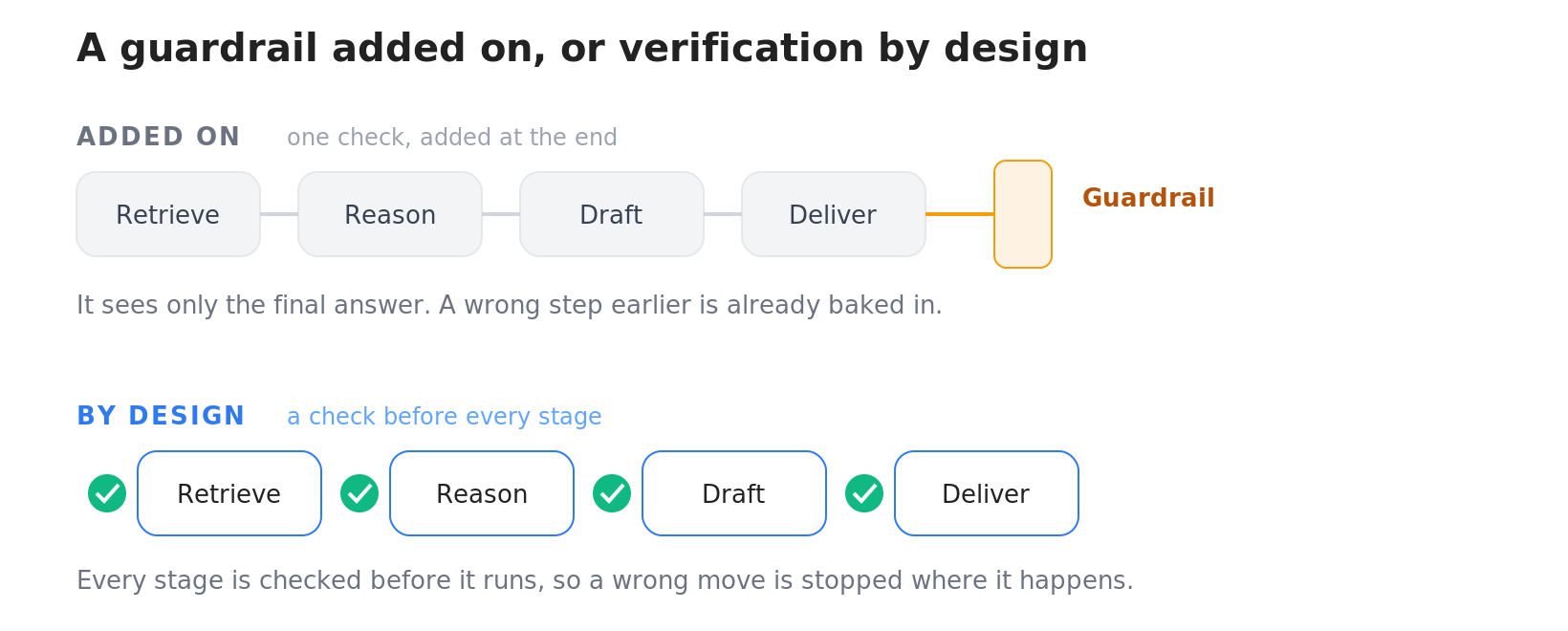
An add-on reacts only at the end. By design, every stage is checked before it passes.
This is also where regulation is heading: the EU AI Act expects high-risk systems to be transparent about their limits, to keep records, and to stay under human oversight, and in financial services DORA pushes the same way on traceability and accountability.
Where Should You Keep a Human?
Not everywhere, because that is slow and it wastes a skilled person on work the machine can carry. You keep a human exactly where a confident wrong answer would cost you, so the routine runs on its own while the judgment calls get escalated to someone who confirms or overrides them on the record. That is not distrust of the tool, it is how you earn the right to trust it.
You do not get to hand off the answer. You are still the one who has to defend it.
How to Evaluate a Verification Approach
Turn the five into a scorecard. For each, here is what good looks like, and the red flag that tells you it is missing.
Check | What good looks like | Red flag |
Refusal | Declines or escalates when it cannot support an answer | Always produces a confident answer |
Citation | Every claim linked to a specific source | Page or document level citations only, or none |
Gap disclosure | States what it could not find or confirm | Output always reads as complete |
Source check | Confirms the claim against the cited source | Retrieves a related source and stops |
Trail | Immutable, reconstructable log of how the answer formed | No record after the fact |
If a system cannot pass this scorecard, it is not ready for a decision that a regulator, an auditor or a board might later question. These same checks map onto what the EU AI Act asks of high-risk systems, so passing them is a head start on compliance, and the runway just grew: under the EU’s Digital Omnibus the high-risk deadlines moved to December 2027 for use-based systems and August 2028 for product-embedded ones (Council of the EU, 2026). That is time to build the discipline in, not to wait.
The Real Takeaway
In regulated industries the next edge is not better citations, it is verification: proof that the answer is right, and not only that it was sourced. Treat a sourced answer as a first draft rather than a verdict, demand the five behaviours, and keep a record you can stand behind.
Sooner or later a regulator, an auditor or a board will ask the one question that matters: how do you know this is correct? “Here is our source” will not be enough. “Here is how we verified it” will. The teams that can say the second sentence are the ones that get to keep using AI at all.
Working on this in a regulated setting? Book a working session with our team to run the five checks against your own AI and set the bar each one has to clear for your obligations.
FAQ
Is a cited AI answer reliable? Not on its own. A citation shows where an answer came from, not that it is correct, and a model can cite the right document while still misreading it. Reliability comes from checking the claim against the source and flagging what could not be confirmed.
Is RAG enough to make AI answers reliable? No. Retrieval-augmented generation grounds an LLM in your documents and reduces hallucination, which is necessary, but it does not verify that a given claim is correct, and it does not make an LLM admit when it does not know. Grounding is the floor, not the finish line.
How do you know if an AI answer is correct, not just sourced? Hold it to five behaviours: it answers only when it can, cites what it used, says what is missing, checks the claim against the source, and logs how the answer was reached. Without them, you can prove that the answer was sourced, not that it was correct.
Does the EU AI Act require verifying AI answers? Not in those words, but for high-risk systems it requires transparency about limitations, record-keeping, accuracy, and human oversight, with those obligations recently pushed back under the Digital Omnibus. The five behaviours above are how you meet them in a working system.
Marianna Printziou is Head of Product at TheFutureCats, where she builds AI products for regulated organisations and trains the teams that use them.
Sources – Stanford HAI, 2026 AI Index Report, Responsible AI chapter (hallucination rates across 26 top LLMs range from 22% to 94%): https://hai.stanford.edu/ai-index/2026-ai-index-report/responsible-ai – Council of the EU, “Artificial intelligence: Council and Parliament agree to simplify and streamline rules” (7 May 2026), high-risk deadlines moved to December 2027 and August 2028: https://www.consilium.europa.eu/en/press/press-releases/2026/05/07/artificial-intelligence-council-and-parliament-agree-to-simplify-and-streamline-rules/